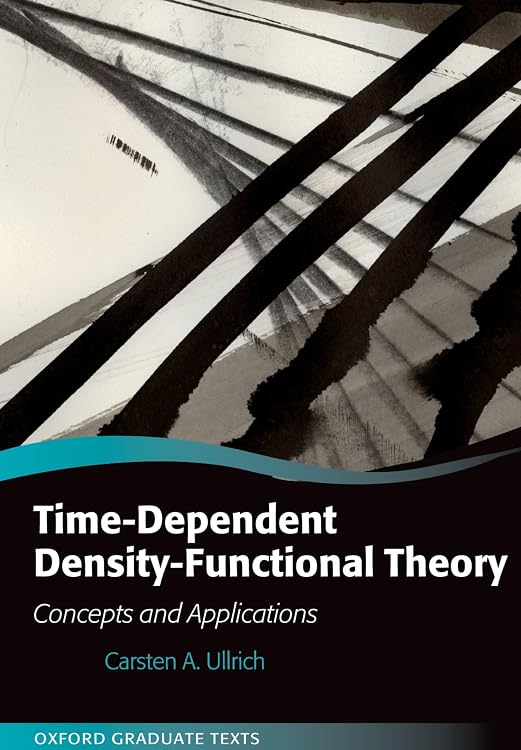
Time-Dependent Density-Functional Theory: Concepts and Applications
Time-Dependent Density-Functional Theory: Concepts and Applications is a graduate-level textbook covering the theory and applications of TDDFT. Its 536 pages range from a review of ground-state DFT and linear-response methods to applications involving molecular excitations, solids and molecular dynamics.
At a glance
- Introduces the formal framework of TDDFT after a self-contained review of ground-state DFT.
- Covers calculating excitation energies with linear-response TDDFT.
- Advanced topics include time-dependent current-density-functional theory, orbital functionals and many-body theory.
- Applications span molecular excitations, ultrafast and strong-field phenomena, excitons in solids, van der Waals interactions, nanoscale transport and molecular dynamics.
- Includes examples, exercises and extensive literature coverage.
Pros and cons
Pros
- The progression from ground-state DFT foundations to advanced TDDFT topics can support structured graduate-level study.
- Examples and exercises provide material for working through the methods, alongside the literature coverage.
Technical specifications
8 specifications| Publisher | Oxford University Press UK |
|---|---|
| Publication date | 14 May 2019 |
| Language | English |
| Print length | 536 pages |
| ISBN-10 | 0198841930 |
| ISBN-13 | 978-0198841937 |
| Weight listed | 907 g |
|---|---|
| Dimensions | 24.38 x 3.05 x 17.02 cm |
Who is it for?
A good fit for
- Graduate students seeking a textbook on TDDFT concepts and applications.
- Readers studying excitation energies, optical properties or the listed molecular, solid-state and dynamical applications.
Less suited to
- Readers looking for a brief introduction rather than a 536-page graduate-level treatment.
Frequently asked questions
What topics does this book cover?
It covers the formal framework of TDDFT, linear-response calculations of excitation energies, advanced theoretical topics and applications including molecular excitations, excitons in solids and molecular dynamics.
Is this an introductory-level book?
The listing describes it as a graduate-level text. It begins with a self-contained review of ground-state DFT before developing TDDFT.
Does the book include exercises?
Yes. The listing says it includes examples and exercises, as well as extensive coverage of the literature.