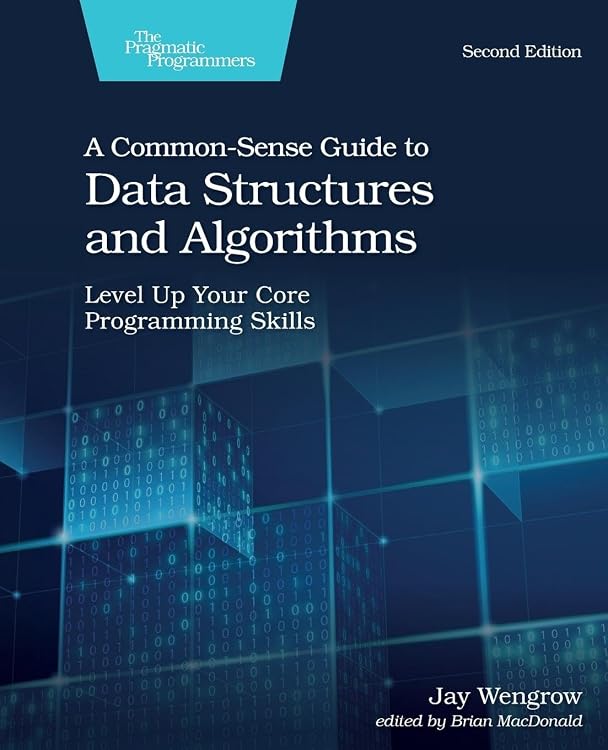
A Common-Sense Guide to Data Structures and Algorithms, 2nd Edition
A Common-Sense Guide to Data Structures and Algorithms is a practical programming book covering Big O notation, core data structures and algorithm techniques. This second edition adds chapters on recursion, dynamic programming, heaps and tries, with exercises and solutions and examples in JavaScript, Python and Ruby.
At a glance
- Uses Big O notation to discuss code efficiency and algorithm choices.
- Covers arrays, linked lists, hash tables, trees and graphs, alongside recursion and dynamic programming.
- Includes chapter exercises with detailed solutions, according to the listing.
- Examples use JavaScript, Python and Ruby.
Often bought together
Pros and cons
Pros
- Practical coverage connects algorithm concepts to everyday code and application scalability.
- Exercises and detailed solutions offer ways to practise the concepts as you read.
- Multiple programming-language examples may help readers compare approaches.
Technical specifications
9 specifications| Publisher | Pragmatic Bookshelf |
|---|---|
| Edition | 2nd |
| Publication date | 21 August 2020 |
| Language | English |
| Print length | 250 pages |
| ISBN-10 | 1680507222 |
| ISBN-13 | 978-1680507225 |
| Weight listed | 934 g |
|---|---|
| Dimensions | 19.05 x 2.59 x 23.5 cm |
What to know before buying
- The listing says examples use JavaScript, Python and Ruby and describes switching between programming languages. Customer feedback is mixed on this language approach, so consider whether multi-language examples suit your learning preference.
Who is it for?
A good fit for
- Programmers seeking an approachable introduction to algorithms and data structures.
- Readers who want to practise Big O reasoning and common structures with exercises.
- Developers looking for examples across JavaScript, Python and Ruby.
Less suited to
- Readers who need instruction exclusively in one programming language.
- Buyers seeking a reference limited to one specific language or a formal mathematics-first treatment.
Customer reviews on Amazon
- 5 stars
85% 85% - 4 stars
12% 12% - 3 stars
2% 2% - 2 stars
0% 0% - 1 star
1% 1%
Customer feedback describes the book as an enjoyable, gentle-to-follow introduction, with positive comments about readability, content and assessing code efficiency. The listing’s multi-language examples may broaden comparisons, but feedback on that approach is mixed, so readers who prefer one language throughout may find it less suitable. The supplied ratings distribution is strongly weighted towards five-star ratings, though ratings alone do not explain individual experiences.
Positive themes
- Customers praise the accessible introduction and easy-to-understand content.
- Feedback highlights readability and coverage of algorithms and data structures.
Mixed feedback
- Customer feedback is mixed on the use of multiple programming languages.
Frequently asked questions
What topics does the book cover?
The listing describes Big O notation, arrays, linked lists, hash tables, trees, graphs, recursion and dynamic programming, among other algorithm topics.
Which programming languages appear in the examples?
The listing names JavaScript, Python and Ruby. Customer feedback is mixed about the multi-language approach, which may be worth considering if you prefer a single-language book.
Does it include exercises?
Yes. The listing says every chapter has practice exercises and detailed solutions.
How long is the book?
The listed print length is 250 pages.