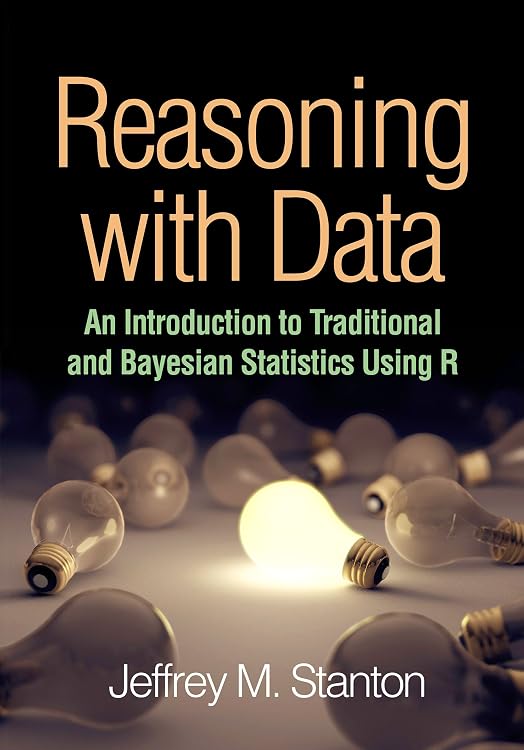
Reasoning with Data: Traditional and Bayesian Statistics Using R
Traditional Statistics: Reasoning with Data is an introduction to classical and Bayesian statistical inference using R. It covers methods such as hypothesis testing, regression and time-series analysis, with real-data examples and exercises aimed at helping readers assess evidence without overinterpreting results.
At a glance
- Explains classical frequentist and Bayesian approaches side by side.
- Topics include hypothesis testing, replication, analysis of variance, effect sizes, regression and time-series analysis.
- Introduces R and key packages through simple commands and real-data examples.
- Exercises use real data supplied in a free R package.
- Appendices cover installing R and working with sample datasets.
Often bought together
Pros and cons
Pros
- Compares two approaches to statistical inference across several techniques.
- Combines statistical concepts with practical R examples and data-based exercises.
- The listing describes a gradual, conversational approach intended to suit readers without strong maths backgrounds.
Technical specifications
9 specifications| Publisher | THE GUILFORD PRESS |
|---|---|
| Publication date | 16 July 2017 |
| Edition | Annotated |
| Language | English |
| Print length | 325 pages |
| ISBN-10 | 9781462530267 |
| ISBN-13 | 978-1462530267 |
| Dimensions | 17.78 x 1.41 x 25.4 cm |
|---|---|
| Weight listed | 581 g |
Who is it for?
A good fit for
- Students learning statistical inference and R together.
- Readers who want to compare frequentist and Bayesian methods.
- Learners looking for exercises based on real data.
Frequently asked questions
What statistical approaches does the book cover?
It presents classical frequentist and Bayesian approaches side by side, including topics such as hypothesis testing, analysis of variance, effect sizes, regression and time-series analysis.
Does the book teach R?
Yes. The listing describes an introduction to R and key packages, with commands used to demonstrate data analysis through real-data examples.
Are exercises included?
The book is described as having end-of-chapter exercises based on real data supplied in a free R package.
What additional resources are described?
The companion website is described as providing annotated R code, in-class exercises, supplemental reading lists, videos, interactive materials and other resources.