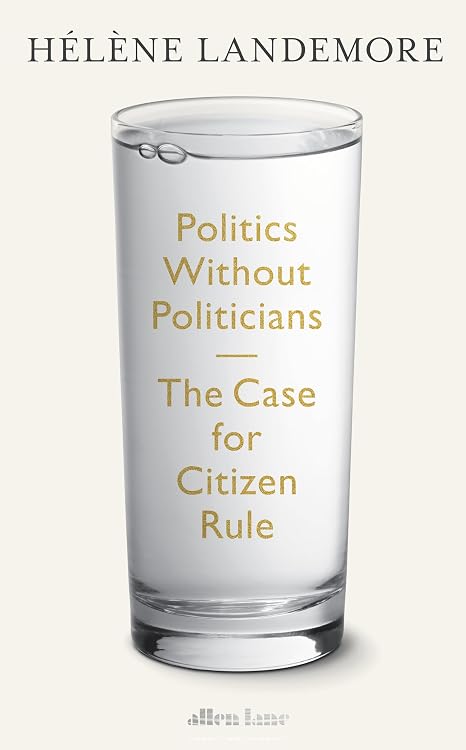
Politics Without Politicians: The Case for Citizen Rule
Politics Without Politicians: The Case for Citizen Rule by Hélène Landemore argues for replacing some electoral decision-making with civic lotteries and citizen assemblies. The book draws on Athenian practices and contemporary deliberative processes, including examples from France.
At a glance
- Makes the case for civic lotteries that select everyday people to govern temporarily.
- Connects ancient Athenian practices with contemporary citizens’ assemblies and deliberative processes.
- Uses examples from France and elsewhere to discuss participation in shaping laws and policies.
Reference price: $55.00
Price checked: 13 Nov 2026
View offerAhead of Black FridayExplore the selectionOften bought together
Pros and cons
Pros
- A focused argument for citizen-led governance, supported by historical and contemporary examples.
- The 320-page length offers room for discussion of both political theory and practical deliberative processes.
Technical specifications
9 specifications| Publisher | Allen Lane |
|---|---|
| Publication date | 12 May 2026 |
| Edition | 1st |
| Language | English |
| Print length | 320 pages |
| ISBN-10 | 0241649161 |
| ISBN-13 | 978-0241649169 |
| Weight listed | 418 g |
|---|---|
| Dimensions | 14.5 x 3.1 x 22.3 cm |
Who is it for?
A good fit for
- Readers interested in democracy, political theory and citizens’ assemblies.
- Those seeking arguments for participatory approaches beyond voting in elections.
Less suited to
- Readers looking primarily for a neutral survey of electoral systems or a practical step-by-step guide to implementing civic lotteries.
Customer reviews on Amazon
- 5 stars
64% 64% - 4 stars
22% 22% - 3 stars
14% 14% - 2 stars
0% 0% - 1 star
0% 0%
Aggregate ratings lean positive, with five- and four-star ratings forming most of the distribution, alongside some three-star ratings. That gives a cautiously favourable signal, but ratings alone do not show what readers valued or where they had reservations.
Frequently asked questions
What is the book’s central proposal?
It argues for civic lotteries that select ordinary citizens to serve as temporary stewards and participate in governing.
What examples does the book draw on?
The description points to ancient Athenian practices and contemporary deliberative processes, including work in France and elsewhere.
Who is likely to find it useful?
Readers interested in democratic reform, political theory and alternatives that involve citizens directly in shaping laws and policies.