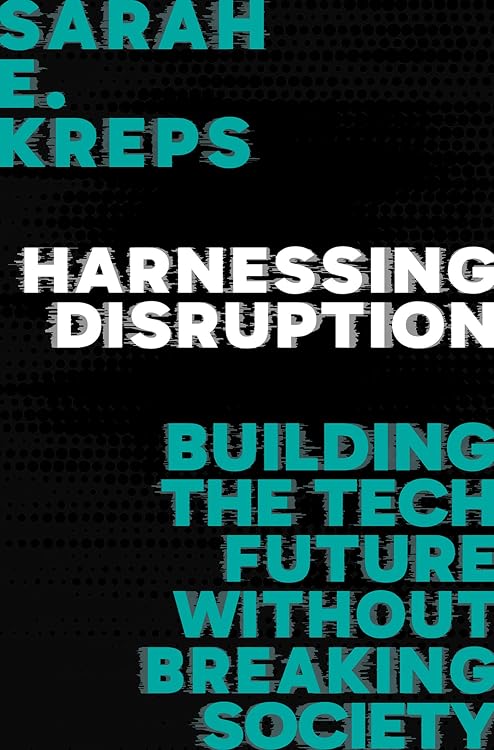
Harnessing Disruption: Building the Tech Future Without Breaking Society
Building Future Without Breaking Society: Harnessing Disruption by Sarah E. Kreps examines how technological change can be understood and governed. The listing describes a five-stage cycle, from a technology’s emergence through institutional response, using examples including nuclear power, AI, cryptocurrency and social media. Its focus is policy and societal responses rather than a technical guide to any one technology.
At a glance
- Presents a five-stage cycle: emergence, early warnings, crisis, agenda-setting and institutional response.
- Uses historical and contemporary examples, including nuclear power, AI, cryptocurrency and social media.
- Frames disruption as a process that institutions and societies can steer, rather than as inevitable collapse.
Pros and cons
Pros
- The cross-technology examples connect debates about AI with earlier and current forms of disruption.
- The five-stage framework offers a structured way to think about how institutions respond to technological change.
Technical specifications
8 specifications| Publisher | Oxford University Press USA |
|---|---|
| Publication date | 6 August 2026 |
| Language | English |
| Print length | 160 pages |
| ISBN-10 | 0197803768 |
| ISBN-13 | 978-0197803769 |
| Weight listed | 376 g |
|---|---|
| Dimensions | 16.36 x 1.63 x 23.52 cm |
What to know before buying
- The listing gives a publication date of 6 August 2026. Confirm availability and edition details if timing matters.
Who is it for?
A good fit for
- Readers interested in technology policy, governance and social change.
- Policymakers, entrepreneurs and citizens seeking a broad framework for considering technological disruption.
Less suited to
- Readers looking for a hands-on technical manual or detailed guidance on a single technology.
Frequently asked questions
What is Harnessing Disruption about?
The listing describes a framework for understanding technological change and societal responses, illustrated with examples such as nuclear power, AI, cryptocurrency and social media.
What is the book’s five-stage cycle?
It is described as emergence, early warnings, crisis, agenda-setting and institutional response.
Is this a technical guide to AI?
No. Based on the listing, it is a broader discussion of disruption, institutions and technology governance, with AI among several examples.