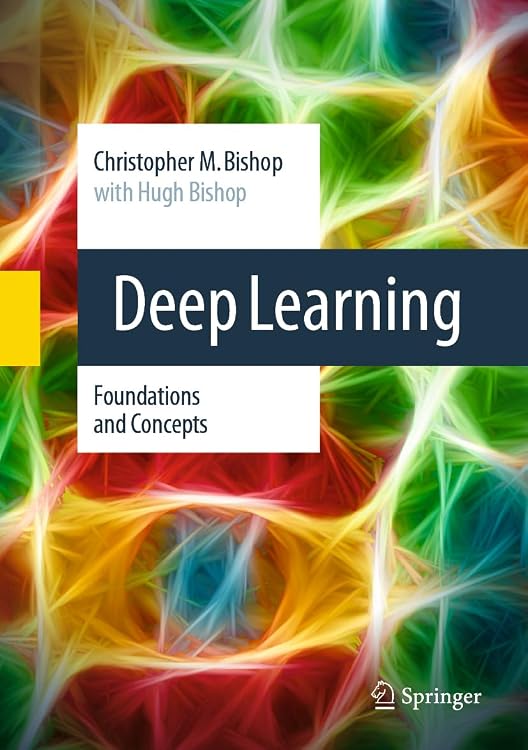
Deep Learning: Foundations and Concepts
Deep Learning: Foundations and Concepts is a 669-page introduction to core deep-learning ideas, intended for newcomers as well as readers with machine-learning experience. It combines explanations, diagrams, equations and pseudo-code, with a self-contained introduction to probability. The publisher describes its chapter sequence as suitable for courses or self-study, while the mathematical content may be demanding for some readers.
At a glance
- Covers core ideas in contemporary deep-learning architectures and techniques.
- Includes a self-contained introduction to probability theory.
- Uses textual explanations, diagrams, mathematical formulae and pseudo-code.
- Chapters progress sequentially and are described as suitable for coursework, research or self-study.
Often bought together
Pros and cons
Pros
- Presents deep-learning concepts through multiple formats rather than relying only on equations.
- Its structured progression can support readers working through topics in sequence.
- The stated 669-page length offers room for a broad introduction to the subject.
Cons
- The mathematical treatment may feel rigorous to readers seeking a mostly non-technical introduction.
- At 1.41 kg and the listed dimensions, this is a substantial physical book to carry.
Technical specifications
9 specifications| Publisher | Springer |
|---|---|
| Publication date | 2 November 2023 |
| Edition | 2024th |
| Language | English |
| Print length | 669 pages |
| ISBN-10 | 3031454677 |
| ISBN-13 | 978-3031454677 |
| Weight listed | 1.41 kg |
|---|---|
| Dimensions | 19.69 x 3.81 x 26.67 cm |
What to know before buying
- The publisher describes the book as an introduction but also says it assumes some mathematical background. Readers should be comfortable with maths or prepared to work through the probability material.
Who is it for?
A good fit for
- Machine-learning students seeking a structured introduction to deep learning.
- Self-directed learners who want explanations alongside diagrams, equations and pseudo-code.
- Readers looking for a textbook that the publisher positions for undergraduate or postgraduate coursework.
Less suited to
- Readers looking for a practical coding workbook or a mathematics-free overview.
- Buyers who need a lightweight, compact book for frequent travel.
Customer reviews on Amazon
- 5 stars
79% 79% - 4 stars
7% 7% - 3 stars
5% 5% - 2 stars
2% 2% - 1 star
7% 7%
Customer feedback describes the book as accessible and well-written, with readers appreciating its explanations of deep-learning methods and theory. The mathematical content receives mixed feedback, with some finding it rigorous. That distinction matters for newcomers: the varied presentation may help with concepts, but the stated probability foundations do not make it a maths-free introduction.
Positive themes
- Customers praise the explanations of deep-learning methods and theory.
- Customers describe the book as accessible and well-written.
Mixed feedback
- Feedback on the mathematical content is mixed, and some customers find it rigorous.
Frequently asked questions
What does the book cover?
The listing describes coverage of core deep-learning ideas, contemporary architectures and techniques, supported by a self-contained probability introduction.
Does it require a mathematical background?
The publisher says some mathematical background is needed and includes probability material. Customer feedback is mixed on the mathematical rigour, so it may be demanding for some readers.
Is it suitable for self-study?
The publisher describes its sequential, bite-sized chapters as suitable for self-study as well as teaching and research.
How large is the book?
The listing gives a print length of 669 pages, a weight of 1.41 kg and dimensions of 19.69 x 3.81 x 26.67 cm.
Alternative options
Machine Learning with PyTorch and Scikit-Learn: Develop machine learning and deep learning models with Python
$75.99
The Hundred-Page Language Models Book: hands-on with PyTorch
$82.44
AI Guide for Beginners: How to Use AI Prompts & Master Artificial Intelligence in 4 Practical Days (21 Days To Make Money With AI Book 1)
$7.99
Building AI Agents with LLMs, RAG, and Knowledge Graphs: A practical guide to autonomous and modern AI agents
$87.56
Introduction to Electrodynamics
$90.75

The Courage to Teach: Exploring the Inner Landscape of a Teacher's Life
$35.75
Making Thinking Visible: How to Promote Engagement, Understanding, and Independence for All Learners
$35.25
In Support of Students: A Leader's Guide to Equitable MTSS
$40.75