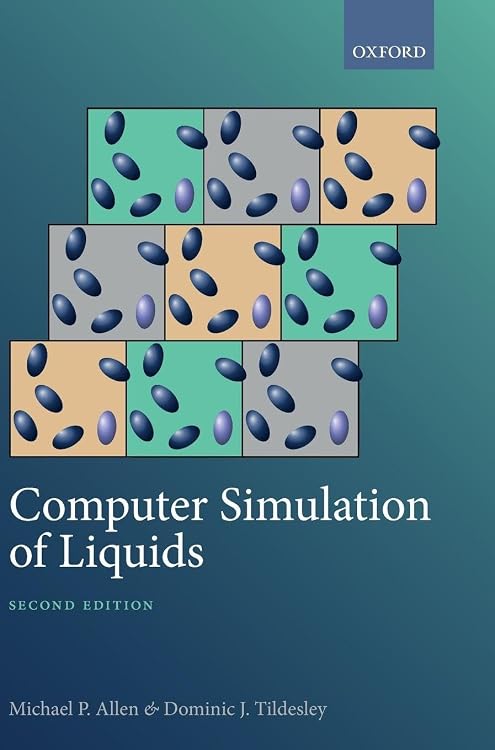
Computer Simulation of Liquids: Second Edition
Computer Simulation of Liquids: Second Edition is a practical guide to molecular dynamics and Monte Carlo methods for modelling simple and complex liquids. It covers how simulation programs work, how to use them and how to interpret results, with accompanying Fortran and Python programs.
At a glance
- Explains molecular dynamics and Monte Carlo simulation techniques for modelling liquids.
- Discusses applications including polymers, gels, colloidal suspensions, liquid crystals, biological membranes and glasses.
- Includes accompanying programs in Fortran and Python for hands-on examples.
Pros and cons
Pros
- Combines explanations of simulation methods with guidance on using programs and interpreting results.
- The supplied code examples use both Fortran and Python.
- Applies to a broad range of fluid and condensed-matter systems.
Technical specifications
9 specifications| Edition | 2nd |
|---|---|
| Publisher | Oxford University Press UK |
| Publication date | 25 May 2017 |
| Language | English |
| Print length | 640 pages |
| ISBN-10 | 0198803192 |
|---|---|
| ISBN-13 | 978-0198803195 |
| Weight listed | 1.34 kg |
|---|---|
| Dimensions | 3.56 x 24.38 x 17.53 cm |
Who is it for?
A good fit for
- Readers learning molecular dynamics and Monte Carlo simulation of liquids.
- Researchers or students interested in computational studies of polymers, colloids, liquid crystals, biological membranes or glasses.
Customer reviews on Amazon
- 5 stars
75% 75% - 4 stars
14% 14% - 3 stars
5% 5% - 2 stars
4% 4% - 1 star
2% 2%
Aggregate customer ratings lean positive, with most ratings in the five-star category, though lower ratings are also present. This gives a generally favourable signal but does not reveal which aspects readers liked or what prompted lower ratings. Consider whether the book's focus on simulation methods and code examples matches your needs.
Frequently asked questions
What topics does the book cover?
It explains molecular dynamics and Monte Carlo simulation techniques for modelling simple and complex liquids, including how to use simulation programs and interpret results.
Does it include programming examples?
The listing says accompanying programs in Fortran and Python provide practical illustrations of the ideas in the text.
How long is the book?
The listed print length is 640 pages.