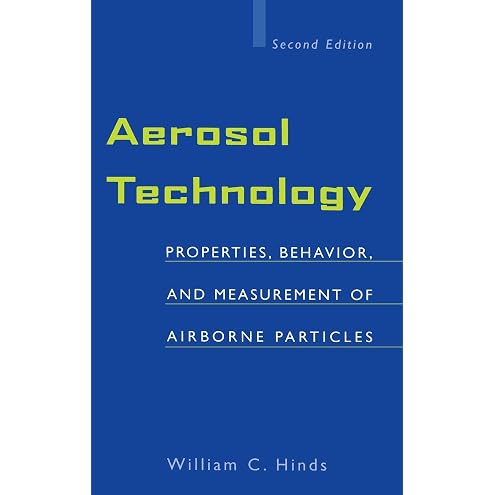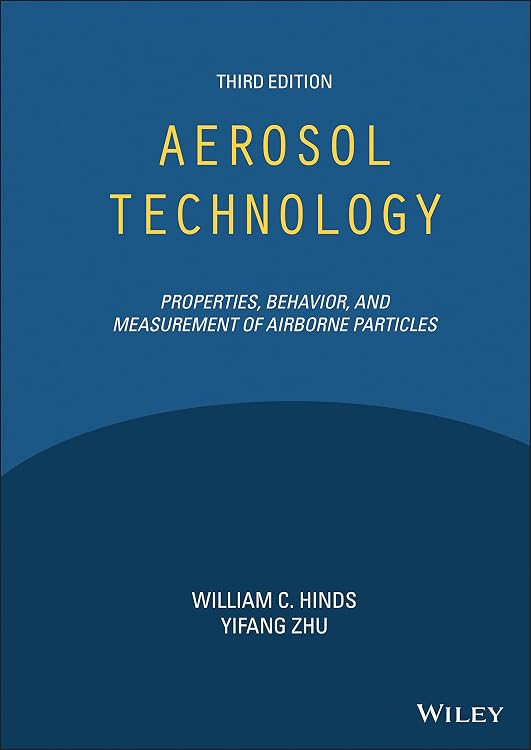
Aerosol Technology, 3rd Edition: Properties, Behavior, and Measurement of Airborne Particles
Properties Behavior Airborne: Aerosol Technology is a third-edition textbook on aerosol theory, particle behaviour and measurement. Its stated coverage ranges from fundamentals and particle motion to sampling, filtration, atmospheric aerosols and modern instruments, with updates on topics including nanoparticles and bioaerosols.
At a glance
- Covers aerosol fundamentals, particle size and shape, particle motion, diffusion, filtration, sampling and concentration measurement.
- The third edition adds discussions of nanoparticles, atmospheric aerosol health effects, remote sensing, bioaerosols, low-cost sensors and modern instruments.
- Includes new exercise problems and examples, according to the listing.
Pros and cons
Pros
- Broadly connects aerosol theory with measurement and application topics relevant to science and technology study.
- The listed subject coverage includes both core particle behaviour and newer application areas such as bioaerosols and low-cost sensors.
Technical specifications
9 specifications| Publisher | Wiley |
|---|---|
| Edition | 3rd |
| Publication date | 27 July 2022 |
| Language | English |
| Print length | 448 pages |
| ISBN-10 | 1119494044 |
| ISBN-13 | 978-1119494041 |
| Weight listed | 239 g |
|---|---|
| Dimensions | 18.03 x 3.05 x 25.4 cm |
What to know before buying
- The listing identifies the edition as 3rd and the publication date as 27 July 2022. Confirm the edition and ISBN match the copy offered if those details matter to your course or reference collection.
Who is it for?
A good fit for
- Senior undergraduate and junior graduate students in science or technology seeking a broad aerosol theory reference.
- Professionals in industrial hygiene, air pollution control, climate science, radiation protection or environmental science, as suggested by the listing.
Frequently asked questions
What subjects does the book cover?
The listing describes aerosol fundamentals and properties, particle motion and diffusion, filtration, sampling and concentration measurement, along with topics such as atmospheric aerosols, coagulation and condensation.
What is new in the third edition?
The listing says the edition adds material on nanoparticles, health effects of atmospheric aerosols, remote sensing, bioaerosols, low-cost sensors and modern instruments, as well as new exercises and examples.
Who is this book intended for?
The listing names senior undergraduate and junior graduate science and technology students, plus professionals in fields including industrial hygiene, air pollution control and environmental science.