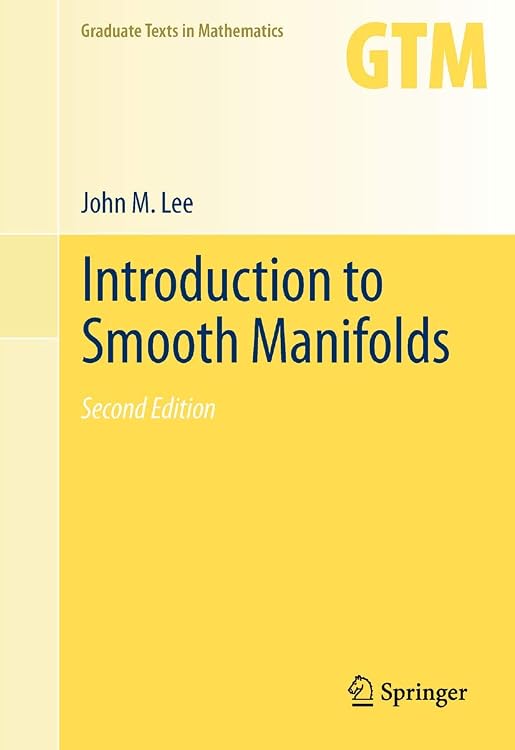
Introduction to Smooth Manifolds, Second Edition
Second Edition: Introduction to Smooth Manifolds is an introductory graduate-level textbook on smooth manifolds, covering core geometric tools and their applications in mathematical and scientific research. Its concrete explanations and diagrams are paired with substantial prerequisites in topology, linear algebra and real analysis.
At a glance
- Covers smooth structures, tangent vectors and covectors, vector bundles, submanifolds, tensors, differential forms and de Rham cohomology.
- Also treats vector fields, flows, foliations, Lie derivatives, Lie groups and Lie algebras.
- The second edition moves the rank theorem and fundamental theorem on flows earlier and adds topics including Sard’s theorem, transversality and contact structures.
- The book describes an approach using pictures and intuitive geometric discussion alongside modern mathematical tools.
Often bought together
Pros and cons
Pros
- Broad coverage connects foundational manifold concepts with differential forms, flows and Lie theory.
- The stated prerequisites are clear, helping prospective graduate readers assess preparation.
- Customer feedback highlights detailed explanations and use for self-study.
Cons
- Customer feedback raises a physical durability concern, including reports that the hardcover falls apart.
- The required background in topology, the fundamental group, covering spaces, linear algebra and real analysis makes this a demanding choice for readers without prior preparation.
Technical specifications
9 specifications| Publisher | Springer |
|---|---|
| Edition | Second Edition 2012 |
| Publication date | 26 August 2012 |
| Language | English |
| Print length | 724 pages |
| ISBN-10 | 1441999817 |
| ISBN-13 | 978-1441999818 |
| Weight listed | 1.16 kg |
|---|---|
| Dimensions | 15.6 x 3.81 x 23.39 cm |
Who is it for?
A good fit for
- Graduate students studying smooth manifolds or differential topology who already have the stated mathematical prerequisites.
- Readers seeking a substantial reference on smooth manifolds, differential forms, Lie theory and related topics.
- Independent learners comfortable with advanced mathematics who want detailed explanations and geometric intuition.
Less suited to
- Readers seeking an introductory text without graduate-level prerequisites.
- Buyers whose main priority is a durable hardcover, given customer reports of binding problems.
Customer reviews on Amazon
- 5 stars
82% 82% - 4 stars
9% 9% - 3 stars
3% 3% - 2 stars
1% 1% - 1 star
5% 5%
Customer feedback is strongly positive about the book’s content and detailed explanations, including its suitability for self-study and differential topology courses. Reports of hardcover copies falling apart raise a practical durability concern, while readability receives mixed feedback. The subject matter and extensive coverage fit graduate study, but readers prioritising a robust physical copy may want to weigh those reported concerns. Aggregate ratings are mostly five-star, though they do not explain individual experiences.
Positive themes
- Customers praise the content and detailed explanations.
- Feedback describes the book as suitable for self-study and differential topology courses.
Negative themes
- Customer feedback reports hardcover durability problems, including copies falling apart.
Mixed feedback
- Readability receives mixed feedback.
Frequently asked questions
What background does this book assume?
The listed prerequisites are a solid acquaintance with general topology, the fundamental group and covering spaces, plus basic undergraduate linear algebra and real analysis.
Which subjects does the book cover?
Topics include smooth structures, tangent vectors and covectors, vector bundles, submanifolds, tensors, differential forms, de Rham cohomology, vector fields, flows, foliations and Lie theory.
What changed in the second edition?
The edition is described as extensively revised and clarified, with rearranged topics, earlier treatment of the rank theorem and flow theorem, and additions including Sard’s theorem, transversality and contact structures.
Is it suitable for self-study?
Customer feedback describes the explanations as detailed and reports suitability for self-study. The substantial prerequisites still make it better suited to readers with a strong mathematical background.
Alternative options
Introduction to Topological Manifolds: 202
$75.81
Introduction to Riemannian Manifolds: 176
$83.14

Numbers: A Math and Thinking Challenge
$13.96
Unboring Pi Mysteries for Kids: Funny, Fascinating Guide to the Most Baffling Pi Mysteries, Number Secrets, and Mathematical Wonders
$26.75

The Communist Manifesto: A revolutionary exploration of class struggle, capitalism’s flaws, and the vision of an egalitarian society shaped by workers and collective power
$17.59

Narrative of the Captivity and Restoration of Mrs. Mary Rowlandson (Large Print Edition): A compelling exploration of one woman’s journey through ... and ultimate redemption in colonial history
$26.39
Introduction to Electrodynamics
$90.75

Trigonometry for High School Success: Clear Concepts, 30 Solved Questions, and Final Exam Review
$21.96
Geometry II – Lines, Angles, & Arcs: (With Answer Key) – Humble Math Geometry Workbook (Book 2) – 100 Days of Geometry
$15.39