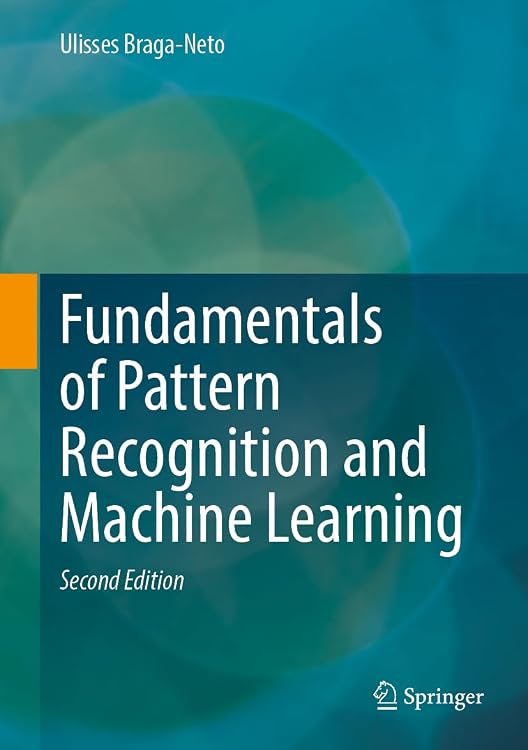
Fundamentals of Pattern Recognition and Machine Learning, Second Edition
Fundamentals of Pattern Recognition and Machine Learning is a mathematically rigorous introduction for graduate students, advanced undergraduates and self-study. The second edition adds physics-informed machine learning and expands its coverage of deep neural networks, with practical examples and coding assignments using Python and Keras/TensorFlow.
At a glance
- Covers classification, dimensionality reduction, regression and clustering, alongside deep neural networks and Gaussian process regression.
- The second edition adds a chapter on physics-informed machine learning and more material on deep neural networks.
- Datasets from bioinformatics and materials informatics illustrate the theory and support coding assignments.
- The book describes its level as graduate or advanced undergraduate, while also presenting itself as suitable for self-study.
Reference price: $109.00
Price checked: 16 Nov 2026
View offerAhead of Black FridayExplore the selectionPros and cons
Pros
- Combines mathematically rigorous material with worked application datasets.
- Coding assignments are based on Python and Keras/TensorFlow, and downloadable plots use Python scripts and Jupyter notebooks.
- Its topic range includes both established methods and newer areas such as physics-informed machine learning.
Technical specifications
9 specifications| Publisher | Springer |
|---|---|
| Edition | Second Edition 2024 |
| Publication date | 7 August 2024 |
| Language | English |
| Print length | 421 pages |
| ISBN-10 | 3031609492 |
| ISBN-13 | 978-3031609497 |
| Dimensions | 17.78 x 2.39 x 25.4 cm |
|---|---|
| Weight listed | 960 g |
What to know before buying
Listing details to confirm
Datasets, coding assignments, scripts and notebooks are described as available from the book website. Access details and the precise contents of the selected print edition are not specified here.
Who is it for?
A good fit for
- Graduate students and advanced undergraduates studying pattern recognition or machine learning.
- Practitioners seeking a mathematically focused reference with applied datasets.
- Self-learners comfortable with technical material and coding exercises.
Less suited to
- Readers seeking a non-mathematical overview or a course text without coding assignments.
Frequently asked questions
What topics does the book cover?
The listing describes classification, dimensionality reduction, regression, clustering, deep neural networks and Gaussian process regression, among other tools.
What is new in the second edition?
It adds a chapter on physics-informed machine learning and additional material on deep neural networks.
Does it include programming exercises?
The listing describes end-of-chapter coding assignments based on Python and Keras/TensorFlow, using datasets from bioinformatics and materials informatics.
Who is the book aimed at?
It is described as suitable for graduate or advanced undergraduate study and self-study, with mathematically rigorous treatment.