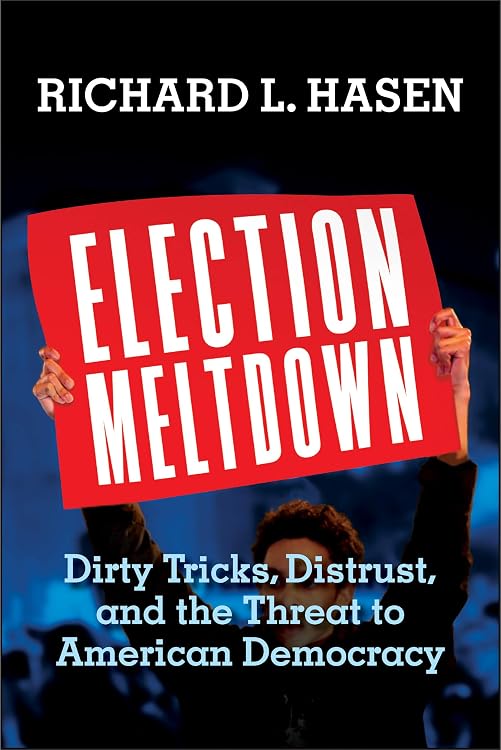
Election Meltdown: Dirty Tricks, Distrust, and the Threat to American Democracy
Dirty Tricks American Democracy: Election Meltdown by Rick Hasen examines how voter suppression, election-administration problems, misinformation and inflammatory claims contribute to distrust in US elections. This 208-page book discusses threats highlighted around the 2016 and 2018 elections and proposes steps to restore trust ahead of the 2020 presidential election.
At a glance
- Explores four sources of mistrust: voter suppression, problems in election administration, misinformation and inflammatory rhetoric.
- Uses examples from the 2016 and 2018 US elections to frame proposed steps for restoring trust.
- Written by election law expert Richard L. Hasen.
Often bought together
Pros and cons
Pros
- Connects several distinct causes of election distrust rather than focusing on misinformation alone.
- Its 208-page length offers a focused treatment of the subject.
Technical specifications
9 specifications| Publisher | Yale University Press |
|---|---|
| Publication date | 10 March 2020 |
| Edition | 1st |
| Language | English |
| Print length | 208 pages |
| ISBN-10 | 0300248199 |
| ISBN-13 | 978-0300248197 |
| Weight listed | 381 g |
|---|---|
| Dimensions | 13.97 x 1.91 x 20.96 cm |
What to know before buying
- The book's analysis focuses on threats to the 2020 US presidential election, so readers seeking coverage of later election cycles should note its publication date.
Who is it for?
A good fit for
- Readers interested in US election law, election administration and democratic institutions.
- Students or general readers seeking a concise analysis of election distrust and misinformation.
Less suited to
- Readers looking for a current account of elections after 2020 or a neutral handbook without an argument about threats to democratic trust.
Customer reviews on Amazon
- 5 stars
62% 62% - 4 stars
12% 12% - 3 stars
20% 20% - 2 stars
3% 3% - 1 star
3% 3%
The supplied aggregate ratings lean positive, with most ratings in the highest category, while a notable share is mid-range and a smaller share is low. That suggests reception is not uniform. The figures alone do not establish which arguments readers valued or disputed, so they offer limited guidance on how well the book's analysis will suit an individual reader.
Frequently asked questions
What topics does Election Meltdown cover?
The listing describes discussion of voter suppression, election-administration problems, domestic and foreign misinformation, and rhetoric about stolen elections.
Which elections inform the book's discussion?
The description highlights developments in the 2016 and 2018 elections and frames the book around the 2020 US presidential election.
Is this a current guide to US elections?
It was published on 10 March 2020 and focuses on threats to the 2020 election. Its publication date matters if you need coverage of later developments.