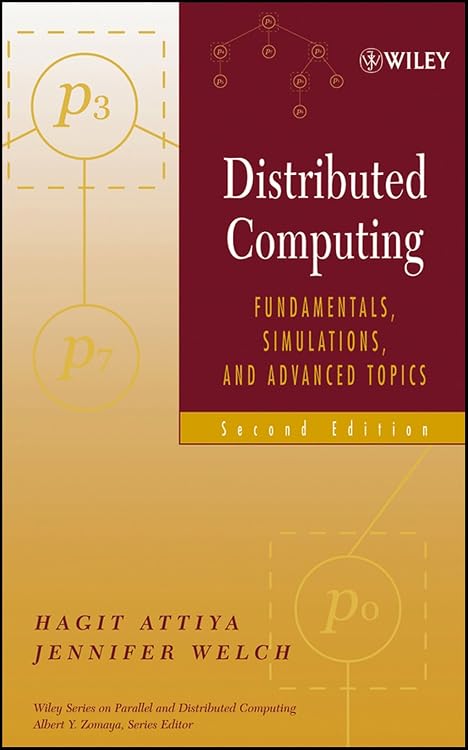
Distributed Computing: Fundamentals, Simulations, and Advanced Topics, 2nd Edition
Distributed Computing: Fundamentals, Simulations, and Advanced Topics is a second-edition textbook on the theory and mathematical foundations of distributed systems. Its stated coverage ranges from communication and coordination fundamentals to algorithms such as consensus and advanced topics including randomization and failure detectors.
At a glance
- Covers communication, coordination, synchronisation and uncertainty in distributed systems.
- Explains leader election, mutual exclusion, consensus, event causality and clock synchronisation.
- Includes simulations between distributed-computing models and advanced subjects such as randomisation, wait-free hierarchy and failure detectors.
- The listing describes the second edition as adding material on fast mutual exclusion and queue locks.
Pros and cons
Pros
- Broad theoretical coverage connects system models, algorithmic concepts and lower-bound techniques.
- Topics span foundational distributed-systems problems as well as advanced material for graduate-level study.
Technical specifications
9 specifications| Publisher | Wiley-Interscience |
|---|---|
| Publication date | 11 March 2004 |
| Edition | 2nd |
| Language | English |
| Print length | 432 pages |
| ISBN-10 | 9780471453246 |
| ISBN-13 | 978-0471453246 |
| Weight listed | 711 g |
|---|---|
| Dimensions | 16.4 x 2.84 x 24.25 cm |
What to know before buying
Listing details to confirm
The title suffix “19” conflicts with the description and edition details identifying this as the second edition. The ISBN-10 and ISBN-13 labels also appear inconsistent with their supplied values. Confirm the intended edition and book identifiers before ordering.
Who is it for?
A good fit for
- Graduate and advanced undergraduate students studying distributed computing.
- Researchers and practising professionals seeking a theoretical reference on distributed algorithms.
Customer reviews on Amazon
- 5 stars
25% 25% - 4 stars
53% 53% - 3 stars
22% 22% - 2 stars
0% 0% - 1 star
0% 0%
Only aggregate ratings are provided, with no review text to explain the reasons behind them. The rating distribution is concentrated in the middle-to-high categories but includes mixed assessments. That offers limited guidance about the book's suitability, so use the stated subject coverage and check the edition details against your course or reference needs.
Frequently asked questions
What subjects does this book cover?
The listing describes communication models, timing, failures, correctness proofs, lower bounds, leader election, mutual exclusion, consensus, causality, clock synchronisation, model simulations and several advanced topics.
Which edition is listed?
The product details say “2nd” edition and the description calls it the Second Edition, but the title ends in “19”. Check the edition and identifiers with the seller before purchasing.
Who is the book intended for?
The listing presents it as a textbook for graduate and advanced undergraduate students, as well as a reference for researchers and practising professionals.