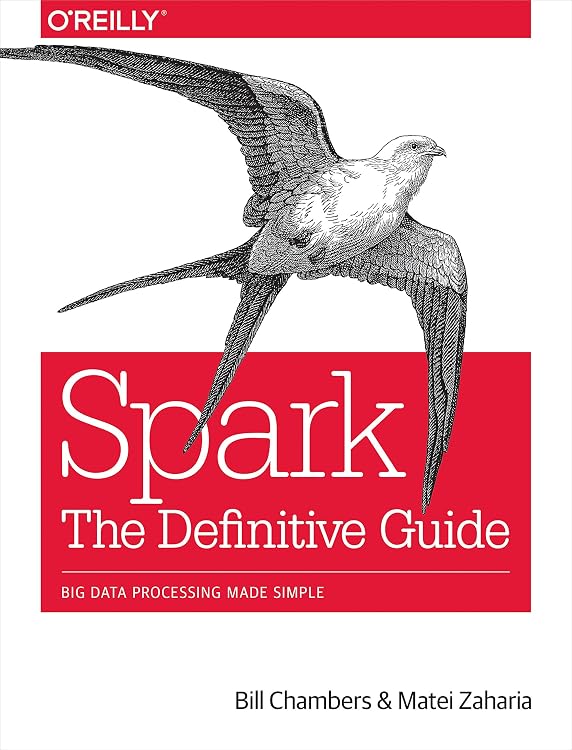
Spark: The Definitive Guide — Apache Spark
Spark: The Definitive Guide is a 603-page guide to Apache Spark, written by framework creators Bill Chambers and Matei Zaharia. It focuses on Spark 2.0’s structured APIs, with examples and material on streaming, cluster operation and MLlib. The book is aimed mainly at data scientists and data engineers.
At a glance
- Covers Spark DataFrames, Datasets and Spark SQL through worked examples.
- Includes Structured Streaming, Spark cluster execution, monitoring, debugging and tuning.
- Introduces MLlib workflows, including classification and recommendation use cases.
- Discusses Python, Java, Scala and R within Spark’s parallel data-processing ecosystem.
Often bought together
Pros and cons
Pros
- Broad coverage spans foundational Spark operations, structured APIs and practical application development.
- Examples are part of the stated approach, which can help readers follow concepts in context.
- Includes operational topics such as monitoring, debugging and configuration alongside programming.
Cons
- Machine-learning techniques are demonstrated through Spark libraries rather than taught in depth, so prior ML knowledge is assumed.
- The book gives less emphasis to older RDD and DStream APIs, making it a less direct fit for maintaining legacy applications.
- It is focused more on application development than administering multi-user Spark clusters.
Technical specifications
9 specifications| Publisher | O'Reilly Media |
|---|---|
| Publication date | 3 April 2018 |
| Edition | 1st |
| Language | English |
| Print length | 603 pages |
| ISBN-10 | 1491912219 |
|---|---|
| ISBN-13 | 978-1491912218 |
| Weight listed | 210 g |
|---|---|
| Dimensions | 17.78 x 3.18 x 22.86 cm |
What to know before buying
- The book centres on Apache Spark 2.0-era structured APIs. Readers working with later versions or legacy RDD and DStream applications should check whether its material fits their needs.
Who is it for?
A good fit for
- Data scientists learning Spark for interactive analysis and statistical modelling.
- Data engineers building data preparation, ingestion or production applications.
- Readers seeking an introduction to DataFrames, Datasets, Spark SQL and Structured Streaming.
Less suited to
- Readers seeking a formal, in-depth introduction to machine-learning methods.
- Administrators looking for a dedicated guide to managing large, multi-user Spark clusters.
- Readers whose main need is maintaining older RDD- or DStream-based applications.
Customer reviews on Amazon
- 5 stars
71% 71% - 4 stars
20% 20% - 3 stars
6% 6% - 2 stars
1% 1% - 1 star
2% 2%
Customer feedback describes the book as thorough, with useful examples and coverage of both Spark fundamentals and advanced topics. Readers’ experiences are mixed on organisation and readability, including reports that code blocks can be difficult to read. Opinions on value also differ. Its breadth suits readers wanting a substantial Spark reference, while the reported presentation concerns may matter to those who rely on clear code formatting.
Positive themes
- Customers praise the breadth of Spark coverage and the helpful examples.
Negative themes
- Some customers report that code blocks are difficult to read.
Mixed feedback
- Feedback differs on how clearly the material is organised and on whether the book is worth its cost.
Frequently asked questions
What topics does this Spark book cover?
It covers Spark fundamentals, structured APIs including DataFrames, Datasets and SQL, Structured Streaming, cluster execution and operations, and use of MLlib.
Is it suitable for someone new to machine learning?
It explains how to use Spark’s machine-learning library but assumes a basic background in machine learning and does not teach the methods in depth.
Is this a good fit for maintaining a legacy Spark application?
It gives less emphasis to RDDs and DStreams than to newer structured APIs, so it may be a poor fit if legacy API maintenance is your main goal.
Who is the book intended for?
The publisher describes it as aimed mainly at data scientists and data engineers using Spark for analysis, modelling and application development.
Alternative options
Designing Data-Intensive Applications: The Big Ideas Behind Reliable, Scalable, and Maintainable Systems
$64.00
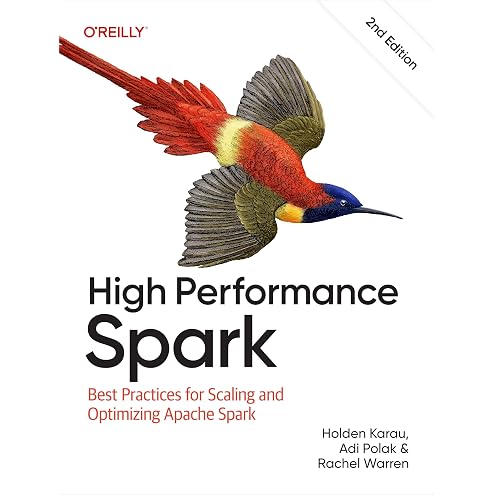
High Performance Spark: Best Practices for Scaling and Optimizing Apache Spark
$60.99
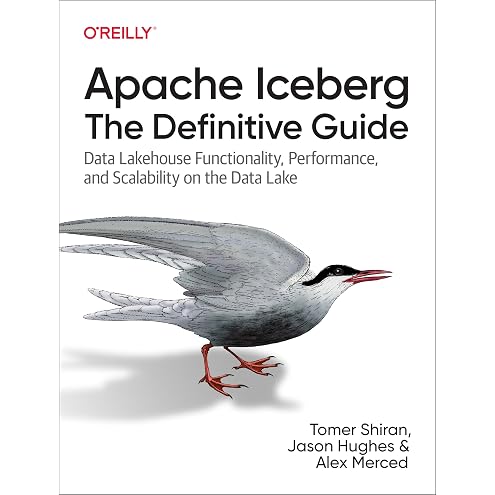
Apache Iceberg: The Definitive Guide: Data Lakehouse Functionality, Performance, and Scalability on the Data Lake
$64.75
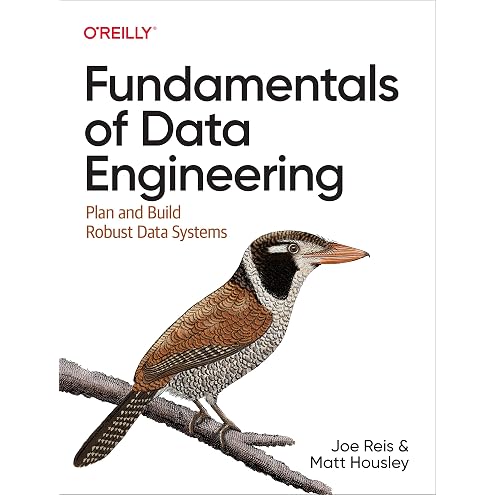
Fundamentals of Data Engineering: Plan and Build Robust Data Systems
$59.99
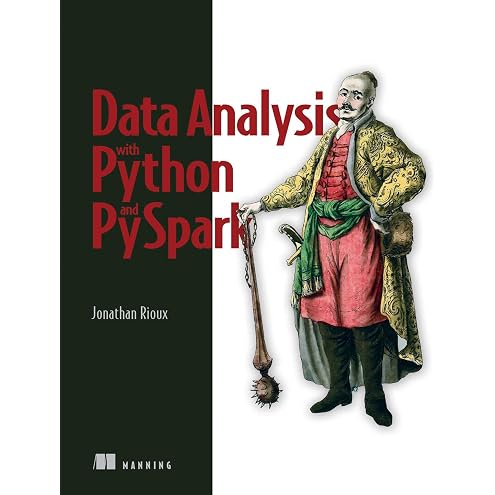
Data Analysis with Python and PySpark
$90.26

The Sokolov Agenda: A gripping action spy thriller
$1.49

Run and Hide (An Eva Driscoll Thriller Book 1)
$6.99

Following His Rules : A brother's best friend office romance (The Tempter Series Book 1)
$4.99

MICROSOFT COPILOT-BENUTZERHANDBUCH FÜR ANFÄNGER BIS PROFIS: Meistern Sie intelligente KI-Automatisierung, bleiben Sie auf dem Laufenden, verbessern Sie die Zusammenarbeit und transformieren Sie sich
$33.09
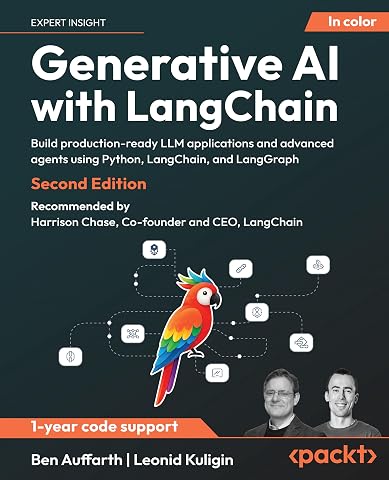
Generative AI with LangChain - Second Edition: Build production-ready LLM applications and advanced agents using Python, LangChain, and LangGraph
$85.68
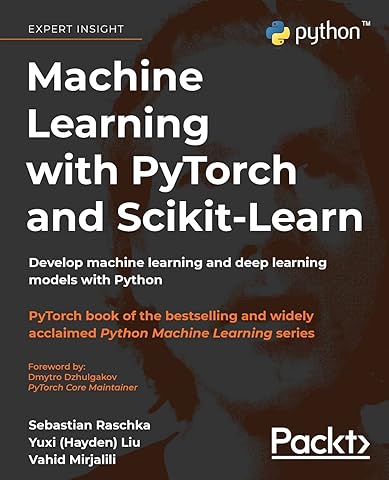
Machine Learning with PyTorch and Scikit-Learn: Develop machine learning and deep learning models with Python
$75.99
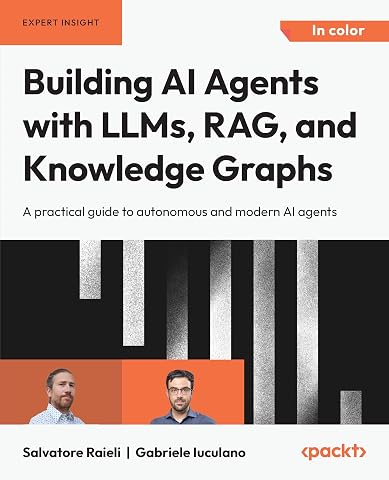
Building AI Agents with LLMs, RAG, and Knowledge Graphs: A practical guide to autonomous and modern AI agents
$87.56