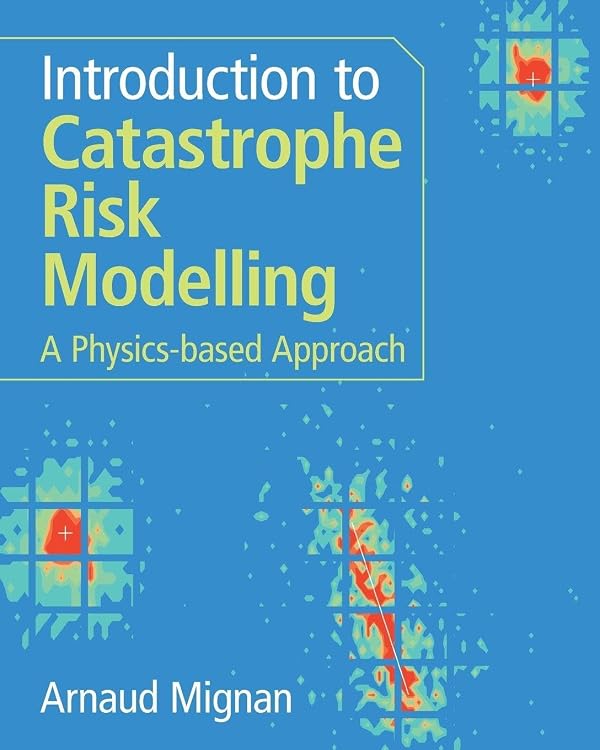
Introduction to Catastrophe Risk Modelling: A Physics-based Approach
Physics-based Approach: Introduction to Catastrophe Risk Modelling is a textbook for advanced students that explains catastrophe risk through physics and related disciplines. It covers a broad range of natural and human-caused perils and describes modelling from hazard through loss assessment, with online resources including a starter kit and Python Jupyter tutorial.
At a glance
- Introduces catastrophe risk modelling through the physics of catastrophe processes, alongside statistics, environmental sciences, civil engineering and psychology.
- Covers geophysical, hydrological, meteorological, climatological, biological, extraterrestrial, technological and socio-economic perils, including domino effects and global warming.
- Describes tools for developing a catastrophe model from hazard to loss assessment.
- The listing describes online resources including a CAT risk model starter kit and a Python Jupyter tutorial sandbox.
- Equations, pseudocode and illustrations are presented as reproducible learning material.
Often bought together
Pros and cons
Pros
- Broad coverage connects hazard processes with loss assessment rather than focusing on a single peril type.
- The described online starter kit and Python tutorial offer practical resources alongside the conceptual material.
- At 368 pages, the listing describes a substantial textbook rather than a short overview.
Technical specifications
8 specifications| Publisher | Cambridge University Press |
|---|---|
| Publication date | 21 November 2024 |
| Language | English |
| Print length | 368 pages |
| ISBN-10 | 1009437348 |
| ISBN-13 | 978-1009437349 |
| Weight listed | 800 g |
|---|---|
| Dimensions | 20.32 x 2.16 x 25.4 cm |
What to know before buying
- The listed online resources are described as included, but access arrangements and continued availability are not specified. The book is addressed directly to advanced students, so readers seeking a non-technical introduction may find its scope less suitable.
Who is it for?
A good fit for
- Advanced students studying catastrophe risk modelling, applied physics or environmental risk.
- Readers seeking an interdisciplinary overview of hazards and the steps from hazard analysis to loss assessment.
- Learners interested in working through modelling concepts with equations, pseudocode and Python tutorial resources.
Less suited to
- Readers wanting a purely non-technical introduction or a book limited to one specific peril.
Frequently asked questions
What does this book cover?
The listing describes an interdisciplinary introduction to catastrophe processes and risk quantification, spanning natural and human-caused perils and modelling from hazard to loss assessment.
Is it aimed at beginners?
The listing says it is addressed directly to advanced students, while focusing on fundamental concepts. It may suit readers with relevant study experience better than readers seeking a non-technical introduction.
Are practical learning resources described?
Yes. The listing describes an online CAT risk model starter kit and a sandbox with a Python Jupyter tutorial, alongside reproducible equations, pseudocode and illustrations.