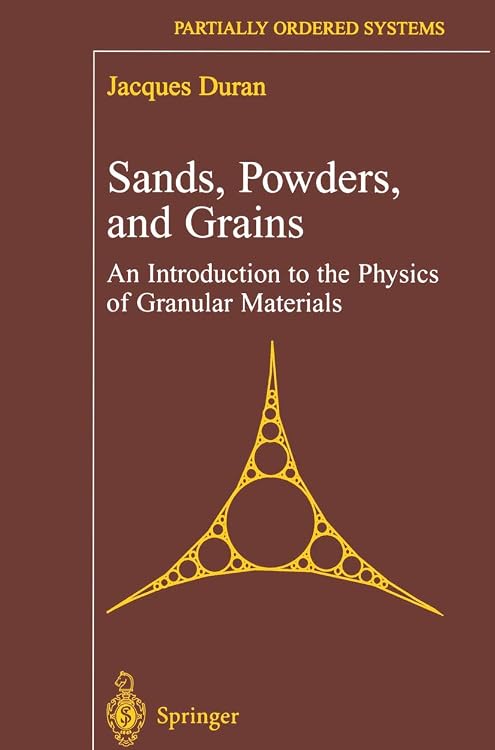
Sands, Powders, and Grains: Physics of Granular Materials
Sands, Powders, and Grains is an introduction to the physics of granular materials, covering their basic properties, mixing and segregation, and numerical models. Its examples range from beaches and grain elevators to planetary rings and interstellar dust.
At a glance
- Introduces the basic properties of uniform granular materials.
- Covers mixing and segregation in heterogeneous materials, including the brazil-nut problem.
- Includes numerical models and examples spanning everyday materials to cosmic dust.
Reference price: $179.00
Price checked: 16 Nov 2026
View offerAhead of Black FridayExplore the selectionPros and cons
Pros
- The stated scope connects foundational concepts with mixing, segregation and numerical modelling.
- Examples across varied scales may help readers relate granular physics to different settings.
Technical specifications
9 specifications| Publisher | Springer |
|---|---|
| Publication date | 12 November 1999 |
| Edition | 2000th |
| Language | English |
| Print length | 228 pages |
| ISBN-10 | 0387986561 |
| ISBN-13 | 978-0387986562 |
| Weight listed | 431 g |
|---|---|
| Dimensions | 15.24 x 1.91 x 22.86 cm |
Who is it for?
A good fit for
- Readers seeking an introduction to granular-material physics.
- Students or researchers interested in particle mixing, segregation or numerical models.
Less suited to
- Readers looking for a recent publication or a practical handbook rather than an introductory text.
Customer reviews on Amazon
- 5 stars
35% 35% - 4 stars
65% 65% - 3 stars
0% 0% - 2 stars
0% 0% - 1 star
0% 0%
Aggregate ratings lean towards four- and five-star assessments, but the available sample is small and no written feedback is supplied. The ratings alone do not identify specific strengths or concerns, so buyers should judge the book by its stated introductory scope and topics.
Frequently asked questions
What topics does Sands, Powders, and Grains cover?
The listing describes basic properties of uniform granular materials, mixing and segregation in heterogeneous materials, and numerical models.
Who may find this book useful?
It may suit readers seeking an introduction to granular physics, especially those interested in particle mixing, segregation or numerical modelling.
How long is the listed edition?
The product details list 228 pages.