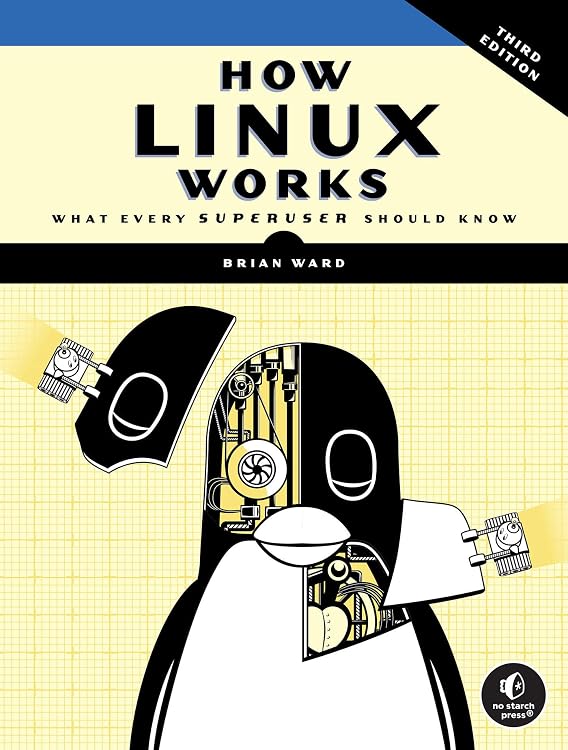
How Linux Works, 3rd Edition — Brian Ward
Brian Ward: How Linux Works, 3rd Edition explains Linux internals, from booting and kernel tasks to networking, shell scripting and filesystems. Its coverage of LVM, systemd, IPv6, virtualisation and containers makes it relevant to readers who want to understand what happens beneath the desktop, though customer feedback is mixed on how deep some explanations go.
At a glance
- Explains Linux booting, including boot loaders and init with systemd.
- Covers kernel roles, devices, drivers and processes, plus networking, interfaces, firewalls and servers.
- This edition adds coverage of LVM, journald, IPv6, virtualisation, containers and cgroups.
- Also covers development tools, shared libraries, shell scripting and filesystem maintenance.
Reference price: $120.00
Price checked: 13 Nov 2026
View offerAhead of Black FridayExplore the selectionOften bought together
Pros and cons
Pros
- Broad coverage links Linux system internals with practical administration topics such as networking, logging and filesystems.
- The listing says readers need basic computer-user knowledge, not programming experience, and should be willing to experiment.
Cons
- The book’s wide range of topics may not provide the depth every reader wants. Customer feedback is mixed on whether explanations are sufficiently detailed.
Technical specifications
9 specifications| Publisher | NO STARCH |
|---|---|
| Publication date | 20 July 2021 |
| Edition | 3rd |
| Language | English |
| Print length | 464 pages |
| ISBN-10 | 1718500408 |
| ISBN-13 | 978-1718500402 |
| Weight listed | 856 g |
|---|---|
| Dimensions | 17.8 x 2.7 x 23.5 cm |
What to know before buying
Listing details to confirm
The listing describes the book as an in-depth guide, while customer feedback is divided on whether some explanations feel thorough or superficial. Consider whether a broad systems overview or deeper treatment of a specific subject better suits your needs. The listing says the text covers systemd-based installations.
Who is it for?
A good fit for
- Linux users who want to understand boot processes, kernel activity and networking rather than only use a desktop interface.
- Readers comfortable with basic computer use who are ready to experiment with a Linux system.
- Administrators or learners seeking a broad reference spanning systemd, LVM, IPv6, containers and shell scripts.
Less suited to
- Readers seeking a narrowly focused, advanced reference on just one Linux subsystem.
- Readers who want a programming-only tutorial or a guide limited to command-line basics.
Customer reviews on Amazon
- 5 stars
83% 83% - 4 stars
13% 13% - 3 stars
2% 2% - 2 stars
1% 1% - 1 star
1% 1%
Customer feedback highlights the book's informative content, readable writing and ability to break down complicated Linux topics, including kernel material. Readers differ on how deep or thorough the explanations feel, and opinions on value are mixed. For buyers seeking a wide-ranging introduction to booting, networking and system internals, that breadth is useful, but those needing detailed treatment of one subject may want a more focused reference. Aggregate ratings are generally positive, though ratings alone do not explain the differing views on depth.
Positive themes
- Customers describe the content as informative and the writing as easy to read.
- Feedback highlights explanations that make complicated topics more approachable.
Mixed feedback
- Customers disagree on whether the explanations are consistently thorough or sometimes superficial.
- Opinions on value for money are mixed.
Frequently asked questions
What Linux topics does this edition cover?
The listing describes coverage of booting, the kernel, devices and processes, networking, firewalls, servers, development tools, shell scripts and filesystem maintenance. New or expanded material includes LVM, journald, IPv6, systemd, virtualisation, containers and cgroups.
Do I need programming experience to read it?
The listing says programming experience is not required. It recommends basic computer-user knowledge, familiarity with files and directories, and a willingness to experiment with a computer.
Is this a beginner's book?
It is presented as an accessible guide to Linux internals for readers with basic computer knowledge. Its broad technical subject matter may still be demanding for someone new to computers.
What do customers say about the explanations?
Customer feedback describes the book as informative, readable and well written, but opinions differ on whether its explanations are consistently thorough or sometimes superficial.