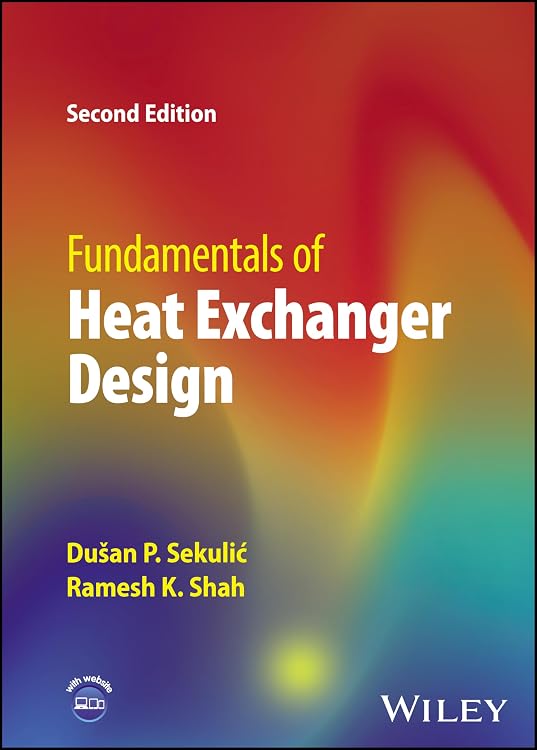
Fundamentals of Heat Exchanger Design, 2nd Edition
Fundamentals of Heat Exchanger Design is a second-edition reference on exchanger design and performance for engineers and advanced engineering students. It covers core heat-transfer concepts, design methods and exchanger types, with added material on manufacturing compact exchangers, including additive manufacturing.
At a glance
- Covers heat transfer fundamentals, design methodology and the theory of different heat exchanger types.
- Includes material on recuperators, regenerators, pressure-drop analysis, geometric parameters and heat-transfer correlations.
- The second edition adds sections on manufacturing compact exchangers and additive manufacturing approaches.
Pros and cons
Pros
- Broad coverage makes it a single-volume reference spanning fundamentals and exchanger design topics.
- The added manufacturing sections address compact heat exchangers and additive manufacturing.
Technical specifications
9 specifications| Edition | 2nd |
|---|---|
| Publisher | Wiley |
| Publication date | 10 January 2024 |
| Language | English |
| Print length | 768 pages |
| ISBN-10 | 1119883261 |
| ISBN-13 | 978-1119883265 |
| Weight listed | 215 g |
|---|---|
| Dimensions | 18.42 x 5.08 x 25.4 cm |
Who is it for?
A good fit for
- Practising engineers working with heat exchanger design or performance.
- Advanced undergraduate and graduate students in mechanical, aerospace or energy engineering and related fields.
Less suited to
- Readers seeking a brief introductory overview rather than a detailed technical reference.
Frequently asked questions
What topics does this edition cover?
It covers heat-transfer concepts, design methods and exchanger types, with discussions of recuperators, regenerators, pressure drop, geometry and heat-transfer correlations.
What is new in the second edition?
The listing describes new sections on design for manufacturing compact heat exchangers and additive manufacturing approaches for compact exchanger design.
Who is this book aimed at?
It is described as suitable for practising engineers and advanced undergraduate or graduate students in mechanical, aerospace and energy engineering, among related subjects.