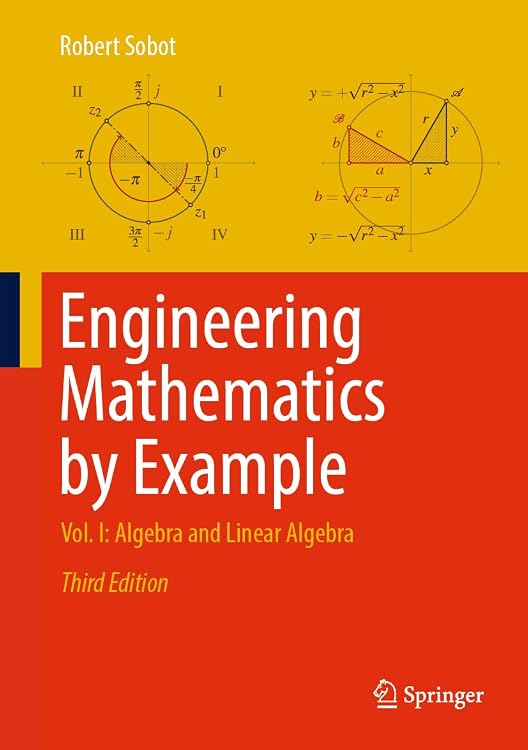
Engineering Mathematics by Example, Vol. I: Algebra and Linear Algebra
Engineering Mathematics by Example Vol. I covers algebra and linear algebra through worked mathematical problems. Its self-study approach focuses on practical problem-solving techniques for engineering and science, with less emphasis on formal rigour.
At a glance
- Self-study and tutorial-style problems focus on practical mathematical techniques.
- Volume I covers algebra and linear algebra.
- The broader series separates calculus and transform-related topics into later volumes.
Reference price: $199.00
Price checked: 13 Nov 2026
View offerAhead of Black FridayExplore the selectionPros and cons
Pros
- The problem-focused format is aimed at practising techniques used in engineering and science.
- The listed 552-page length provides substantial material within this volume.
Technical specifications
9 specifications| Publisher | Springer |
|---|---|
| Edition | Third Edition 2025 |
| Publication date | 1 May 2025 |
| Language | English |
| Print length | 552 pages |
| ISBN-10 | 3031810759 |
| ISBN-13 | 978-3031810756 |
| Weight listed | 1.17 kg |
|---|---|
| Dimensions | 17.78 x 3.02 x 25.4 cm |
What to know before buying
- The book description says formal rigour is reduced, so readers seeking a theory-heavy treatment may prefer a more formal textbook.
Who is it for?
A good fit for
- Engineering and science students practising algebra and linear algebra problems.
- Independent learners seeking a tutorial-style mathematics resource.
Less suited to
- Readers seeking a rigorous, theory-first treatment of mathematics.
- Buyers looking for the calculus or transforms topics, which are assigned to other volumes.
Frequently asked questions
What topics does Volume I cover?
The title and description identify algebra and linear algebra, with practical problem-solving techniques.
Is this intended for self-study?
Yes. The listing describes it as a self-sufficient, self-study and tutorial-style source of mathematical problems.
Does this volume cover calculus?
No. The listing assigns calculus to Volume II and signal-processing-related convolution, Fourier and Laplace examples to Volume III.
How formal is the treatment?
The description says mathematical rigour and formalism are reduced in favour of practical techniques.