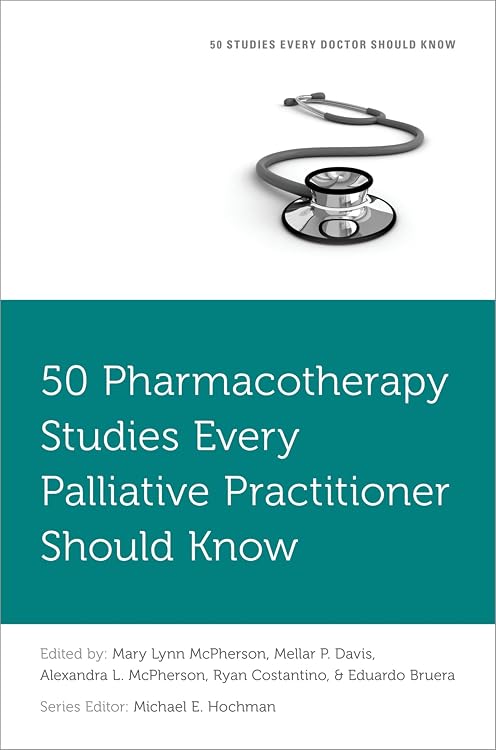
50 Pharmacotherapy Studies Every Palliative Practitioner Should Know
50 Pharmacotherapy Studies Every Palliative Practitioner Should Know brings together concise summaries of selected studies relevant to palliative pharmacotherapy. It covers topics including pain, nausea, delirium, dyspnoea and cachexia, with study limitations, practice implications and illustrative clinical cases.
At a glance
- Summarises 50 pharmacotherapy studies selected for relevance to palliative practice.
- Topics include agitation and delirium, fatigue, nausea and vomiting, pain, anorexia and cachexia, ALS, seizures, dyspnoea, anxiety, pruritus, symptom clusters, COPD and cancer.
- Each study summary highlights results, limitations and implications for practice, with brief related-study information and an illustrative clinical case.
- The listing describes selection criteria including citations per year, evidence level, clinical studies and trials, and a three-stage Delphi review by international experts.
Often bought together

Pros and cons
Pros
- Pairs concise study summaries with limitations and practice implications, making the material relevant to evidence-informed clinical learning.
- The topic range spans symptoms and conditions encountered across palliative care, rather than focusing only on one medication or diagnosis.
Technical specifications
7 specifications| Publisher | Oxford University Press USA |
|---|---|
| Publication date | 23 October 2024 |
| Language | English |
| Print length | 352 pages |
| ISBN-13 | 978-0197770337 |
| Weight listed | 508 g |
|---|---|
| Dimensions | 15.65 x 1.85 x 23.5 cm |
What to know before buying
- The listing positions this as a professional reference for palliative practitioners and related clinical roles. It summarises research and should not be treated as a substitute for individual clinical judgement.
Who is it for?
A good fit for
- Palliative practitioners seeking a concise review of influential pharmacotherapy studies.
- Pharmacists, advanced practice nurses and physician assistants working with palliative care evidence.
- Readers who want clinical cases alongside summaries of study results and limitations.
Less suited to
- Readers seeking a general introduction to palliative care rather than a pharmacotherapy-focused research reference.
- Readers looking for a complete textbook or treatment protocol. The listing describes concise summaries of selected studies.
Frequently asked questions
What does the book cover?
The listing names topics including pain, nausea and vomiting, delirium, dyspnoea, fatigue, cachexia, anxiety, seizures, COPD and cancer.
How is each study presented?
The listing says each study has a concise summary focused on results, limitations and implications for practice. Brief information on other studies and an illustrative clinical case are also provided.
Who is the book aimed at?
It is presented for palliative practitioners, pharmacists, advanced practice nurses, physician assistants and others interested in the evidence behind clinical practice.